
'So, what does one believe -- just 6 stocks that are pushing the indices higher or the 600 scrips that are reflecting economic pain?'
Business Standard tracks pollution levels, goods ferried by the Indian Railways and consumer visits to various categories of places, in addition to power generation and traffic numbers to understand the fast-changing situation on the ground.

Industrial output had slowed to 5-month low of 2.1% in March.

It's a clear signal that Indian economy is not out of woods.

It would not be surprising if India, the world's largest producer of milk, has to resort to imports to meet the elevated summer demand, states Surinder Sud.
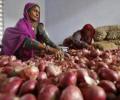
In case of onions, inflation skyrocketed to 127.04 per cent, while for the eggs, meat and fish segment the rate of price rise was 5.76 per cent.
Enthused by higher than expected GDP numbers in the fourth quarter of 2022-23, Chief Economic Adviser (CEA) V Anantha Nageswaran on Wednesday said India's economic growth may exceed the initial estimate of 6.5 per cent in the current fiscal and the country can look for another year of solid economic performance.

Pulled down by the mining and electricity sectors, the Index of Industrial Production stood at 8.8 per cent during April 2005 compared to 8.9 per cent in the same month last year.

IndusInd Bank was the top gainer in the Sensex pack, soaring over 7 per cent, followed by Bharti Airtel, HCL Tech, Tata Steel, Tech Mahindra and Dr Reddy's.
The industrial production grew by two per cent in September, mainly on account of better performance by power and mining sectors.

The wholesale price-based inflation eased marginally to 12.07 per cent in June as crude oil and food items witnessed some softening in prices. However, WPI inflation remained in double digit for the third consecutive month in June, mainly due to a low base of last year. WPI inflation was (-) 1.81 per cent, in June 2020. Snapping the five straight months of uptick, the wholesale price index (WPI)-based inflation in June softened as prices of food articles and crude oil eased, even though manufactured products hardened.
Due to lower output from mines, utilities and factories, the July factory output data came down to 0.5 per cent year-on-year, the government data showed on Friday, down from June's revised 3.9 per cent rise.
'Growth would have to be 7% in the October-March period, if the year as a whole is to clock 6%.' 'Who would bet on that when, in the world of real numbers, both exports and imports have continued to fall, car sales have continued to slump, and the industrial production index shows yet again a drop in output?', asks T N Ninan.

Navi Mutual Fund (MF), among the latest entrants in the Rs 35-trillion industry, is looking to make a mark in the passive investment space, which is gaining traction in the country. The Flipkart co-founder Sachin Bansal-led fund house filed seven offer documents with the market regulator Securities and Exchange Board of India (Sebi) on a single day this week. Some of the schemes Navi MF plans to launch are Navi NASDAQ 100 Fund of Fund, Navi Nifty Commodities Index Fund, Navi Nifty 100 ESG Index Fund.

Factory output, measured in terms of Index of Industrial Production, showed an improvement mainly because of an uptick in mining and manufacturing production and larger offtake of capital goods.

'Just the amount of work which is there just to become more and more successful in banking. For this to happen you need to have leaders who understand technology.'

The NSE index Nifty ended above the 10,500-mark.
The change in the baseline for IIP and WPI, currently at 2004-05, is expected to bring in more accuracy in mapping the level of economic activity and calculating other numbers like national accounts.

Hiring activity witnessed a 6 per cent year-on-year growth in March this year, supported by a rebound in economic activities and led by sectors such as banking and telecom, according to a report. However, there was a marginal dip of 2.4 per cent in hiring activity as compared to February, owing to the appraisal season, according to the Monster Employment Index (MEI). "Two years into the pandemic, it is heartening to see that the Indian economy has overcome setbacks and challenges with hiring momentum exceeding pre-COVID levels by 6 per cent this year compared to 2020," Monster.com, a Quess company, CEO Sekhar Garisa noted.
India Inc has an impressive report card to show for the first quarter of this financial year.
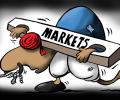
Market cap of government companies has remained unchanged in the past 8 years.

Chief Economic Advisor Krishnamurthy Subramanian said China imports a lot of components, parts, assembles and integrates and then exports them.
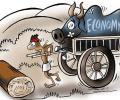
'We expect a pick-up in the second half of the current fiscal. But before that, data is likely to show a further slowdown. The second quarter print is likely to be worse than the first quarter,' said a senior official.
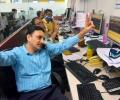
Equity markets began the new financial year with smart gains on Friday, with the Sensex rallying over 708 points to recapture the crucial 59,000-mark following gains in index majors HDFC twins and Reliance Industries, along with foreign fund inflows. On the first day of trading in the new financial year, the BSE barometer rallied 708.18 points or 1.21 per cent to settle at 59,276.69. During the day, it jumped 828.11 points or 1.41 per cent to 59,396.62. The broader NSE Nifty advanced 205.70 points or 1.18 per cent to settle at 17,670.45.

Telecom shares rallied on hopes that they would hike tariffs after huge investments to acquire spectrum.

Hiring for management professionals with greater than 16 years of experience witnessed a spike of 66% compared to last year.
The broader markets ended in line with the benchmark indices- BSE Midcap and Smallcap indices ended higher by 1.3% and 0.9% each.

Notable losers were ONGC, Axis Bank, ITC, SBI, ICICI Bank, NTPC, Hero Motocorp, Sun Pharma and Bharti Airtel who fell by up to 2.80 per cent.

Key macroeconomic indicators suggest softening industrial growth.

10 high dividend paying stocks across sectors that are expected to maintain or even increase their pay-outs in FY23 thanks to faster earnings growth in the last four quarters.

FutureBrand, which is a global brand transformation company, said part of Reliance's success could be attributed to Mukesh Ambani's recasting of the firm as a one-stop-shop for Indians.
The RBI must first deal with the adverse turn of events in the CPI.

Fourth quarter earnings of blue-chips such as Infosys, TCS, Wipro, RIL and inflation data for March will dictate the trend on the bourses in a holiday-shortened week ahead, experts said.

The cooking oil national industry body -- Solvent Extractors' Association (SEA) of India has suggested immediate initiation of government to government (G2G) dialogue with Indonesia on the proposed palm oil export ban from April 28 by them as it would have an adverse repercussions in India. Indonesia, which is the world's largest producer of palm oil and meets nearly 50 per cent of the total palm oil requirement in India annually, had announced to ban exports till further notice apparently to contain edible oil prices in their domestic market. "We have suggested our government initiate dialogue with Indonesian counterparts at the highest diplomatic level on the cooking oil export ban.
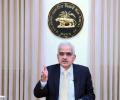
The challenge for the RBI in 2024 is likely to be less about containing elevated inflation and more about curbing excessive financial market exuberance and a 'problem of plenty', notes Sajjid Chinoy, Chief India Economist JP Morgan.

Index of Industrial Production is expected to have grown by 1-2 per cent in April, D&B said in a research note, adding that the pace of improvement in consumption and investment demand is likely to take place as per the measures taken by the new government.
.jpg)
During April-February, the index of industrial production, a measure of factory activity, declined 0.1 per cent compared with a 0.9 per cent growth in the corresponding period of 2012-13.

Prices of food articles contracted by 3.47 per cent in June on a yearly basis. Vegetable inflation stood at (-)21.16 per cent.
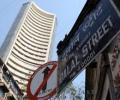
Markets extended losses after the first hour of trade with HDFC Group shares leading the decline.

In the Sensex pack, other gainers were Bajaj Finance, Bharti Airtel, Tata Motors, Hero MotoCorp, HUL, Asian Paints, HDFC duo and ONGC -- gaining as much as 2.87 per cent.
